The 2 Best Ways to Improve Your Writing Skills (with a little backup from Anne Lamott)

I’m going to offer some advice today that seems simplistic, so basic as to be ridiculous. Yet recently, I’ve experienced people who have neglected these 2 important strategies that are pretty much guaranteed to improve their writing abilities. So here I am repeating them.

Almost every book about writing offers the following advice. (The wording might vary according to the delicacy of the audience, but the meaning is the same.)
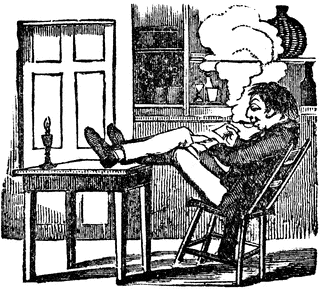
relaxing in a chair

Okay, so you might need more than a chair. This guy isn’t going to get much writing done if he doesn’t pick up a pen!

1) PUT YOUR TUSH IN THE CHAIR.

By this, of course, we learn that if you tell us you want to write, well that’s a nice sentiment. But we know that you mean it if you sit at a desk, pick up a pen (or keyboard) and actually practice writing. Certainly weekly, and preferably daily, you need to write. A human being is only a writer if s/he is a person who writes.  Continue reading

Who’s talking? POV, Voice, and Narrator as explained in Anne Lamott’s Bird by Bird

book cover

Bird by Bird by Anne Lamott

There are few books that come up with my writer friends more often than Anne Lamott’s Bird by Bird. In the same way that I feel like I’m not quite smart enough because I’ve never taken Calculus, I’ve felt like a slacker because I never got around to reading it.

And I should have felt guilty–because it’s great.

Okay, so it has a lot of rather vulgar language, but Lamott’s writing is so funny, and yet so useful, that I’m pretty much in love with the book.

One of the interesting bits of advice that Lamott gives writers is a gem she attributes to the author Ethan Canin. The most important way to improve your writing, he says, is to employ a likeable narrator.

Here’s the thing that struck me about this advice: for many, many years, I always wrote in third person. Continue reading

2 Major differences between writing a picture book and writing short stories

So the folktale project turned out to be an eye-opening experience for me.

scissors

Am I a writer, or a barber?

When I first started writing for kids, I didn’t really understand the difference between short stories and picture books. I’d submit short stories to book publishers, and picture books to magazines who published short stories. Selling Raizy and being guided through revisions by Devorah Leah Rosenfeld, the editor at Hachai, schooled me in the differences between the two media. After a couple years, I started writing regularly for children’s magazines, and her lessons allowed me to jump between the two formats.

2 Major differences between picture books and short stories:


1) The length differs significantly in the two formats. Oddly, an entire picture book has about half the words (sometimes less) as a short story for a kids’ magazine.

2) The illustrations in a picture book replace almost all the description. And the only words that could appear in a picture book text are ones that drive the narrative forward. When I learned this lesson, my picture book writing attained a sharpness that it had previously lacked.

Continue reading

When good things happen to anxious people: the beginning of a new project

parakeet, lineated

I hope I say something original, for once.

I’m close to wrapping a piece for a magazine, and I’m waiting on the opinions of some of the beta readers of one of my WIPs, so Friday morning, I started rummaging though my old journals for some new-old project ideas. Among my scribbling, I found notes about a folktale that really appealed to me. A little research has indicated that there is only one picture book retelling of this story. Which is why, for the first time, I’m attempting a folktale retelling.

Good for me, right? It’s good to try something new, right? Continue reading

Why I think speculative fiction is just SO Jewish (& you should, too)

One of the things I most like to write (and find it hard to sell) is Jewish speculative fiction. Speculative fiction is a wide-ranging label that includes genres like fantasy, science-fiction, and horror. Basically, in speculative fiction, the author suggests a scenario that proposes the question: “What if_______?”

What if…

…you found out that you weren’t a friendless orphan but a powerful wizard with many supporters? (Harry Potter)

…you discovered the back of the wardrobe led into a magical realm where you became royalty? (Narnia)

…you discovered there was a way to communicate with aliens through your dental work? (Fat Men From Space)

…you accidentally returned to the time of the Holocaust during your Pesach Seder? (The Devil’s Arithmetic)

While Isaac Asimov, Jane Yolen, Harlan Ellison, Daniel Manus Pinkwater, and many other secular Jewish Americans (as well as the Orthodox writer, Michael Burstein and the Israeli writers Lavie Tidhar and Nir Yaniv) have written speculative fiction to great acclaim–even Jewish speculative fiction–specifically Orthodox Jewish speculative fiction is much harder to find. As I have mentioned previously on my blog (and again, and again), there has been movement into this direction. But still, I get a lot of funny looks when I tell people what I most like to write.

But I don’t get it. I think speculative fiction is just SO Jewish, and so should you. Here’s why: Continue reading