Clean your file cabinets for Passover: Yet another piece of wacky advice from yours truly

So, in the Klempner household, preparations for Pesach — Passover — are in full swing. We’re vacuuming and scrubbing the house, the car, and the van like crazy. I’m muttering things like, “Why do I let them eat in carpool?” and “How do you get cookie crumbs in sock drawers?” under my breath.

Photo by Pptudela and available through Wikipedia Commons

One of my favorite parts of Pesach cleaning is finding things you’ve lost: the missing token from a game you’ve been wanting to play on rainy days, spare change, receipts for purchases you’ve been meaning to return, missing socks.

I’m not suggesting you pull out the 409 and start scrubbing down your file cabinets (although, if a toddler has access to its drawers, it might be a good idea). I’m suggesting that you flip through some old stories — ones you discarded incomplete, or complete but not yet ready for prime time viewing — and revisit them.
Continue reading

When writing shifts from a hobby to a job: my new essay in Tablet

Meow.

Meow.

Last year, I wrote on this blog that I struggled with creating the annual Purim newsletter I co-write with my husband. Well, this year, I wrote an essay about it for Tablet. You can read it here.

And if you don’t live in L.A., but do want to see this year’s edition of the newsletter (and other freebies throughout the year), you can fill out this form.  I’ll put you on the mailing list!

Go back

Your message has been sent

Warning
Warning
Warning
Warning

Warning.


This Birdie Has Tweeted

I’m mortified. Having recently come to grips with the necessity of getting a Facebook account, I’ve now succumbed to Twitter. You can’t apply for the new Amtrak Artist Residency program without it, and you can’t get some writing gigs without it (because they want you to publicize), and now I’ve joined the flock.

I actually took a class last year about Social Media from Carol Tice and Linda Formacelli, and so I’m not totally incompetent at stuff like this. I just feel like I’m incompetent at this kind of thing.

If you’d like to follow me on Twitter, you can find me @KlempnerJots and read what I’ve got to say about about the world of books and magazines and all sorts of random things that appeal to me.

Megillat Esther through the eyes of a 21st century writer, or It’s okay if G-d saves the day if there’s forshadowing

This year, in preparation for Purim, I’ve been rereading the megillah at a class given by my LOR (local Orthodox rabbi). Of course, it’s not the first time I’ve read The Book of Esther, as it’s called in English. We do that every year on Purim–twice! And it’s also not the first time I’ve learned it with this particular rabbi. But it is the first time I’ve read it with commentary, guided by my rabbi, since I officially became an author (whatever that means). And boy, is there a difference.

The Big Literary No-No All Over the Megillah

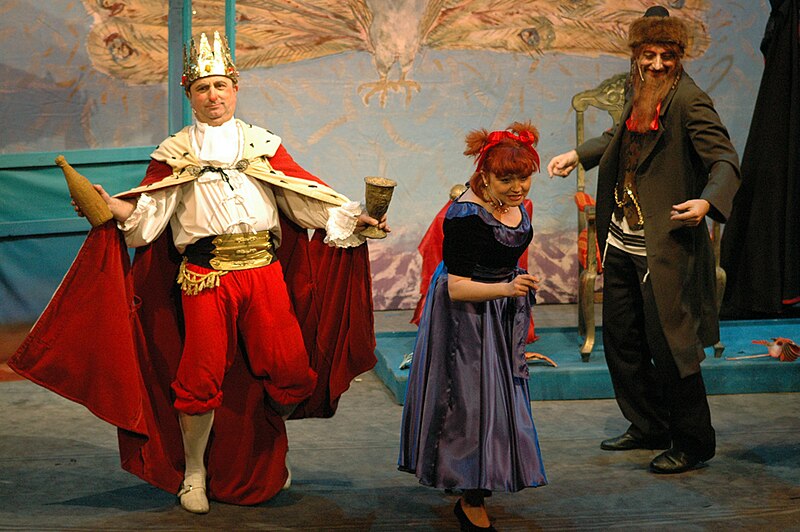
book of esther theater poland

A Purim Spiel in Poland. Photo shared in the Wikipedia Commons by Henryk Kotowski.

When you’re writing fiction, there is a big no-no that you’re told never to do: rely on deus ex machina. In short: don’t get your characters out of a tight corner by dropping a deity down from the sky to perform an instantaneous rescue. The audience will roll their eyes, at best.

The term originated with actors playing deities in the theaters of Greece. But for a religious writer of a different persuasion in the 21st century, it causes problems. Continue reading

How writing a novel differs from writing a screenplay: my last post on STORY

After reading my earlier posts on STORY, you might think I’m 100% sold on the book. I have to admit that I’m a fan, but I do have some quibbles, largely on the adoption of screenwriting techniques for short story or novel writing.

Differences between writing for readers and for viewers that limit the utility of STORY:

1) (The only one I noticed pointed out by McKee) You may get inside the characters heads and explore their thoughts in literature. This creates a greater intimacy between the narrator and the reader. It also means the conflict can be much more subtle and much more interior.

2) Some readers like descriptive, sensory details that can’t be experienced with film — smell and touch can be better evoked, for example (unless you’re viewing in smell-o-rama).

3) The audience must work harder when reading print–in a good way.

4) When contrasted with other useful literary guides, you see some shortfalls. Continue reading

Most writers procrastinate. But why?

My best friend and fellow writer, Cy, sent me a link to an article in the current Atlantic about why writers are infamous procrastinators. Read it here and tell me what you think. And don’t forget to include the reasons you procrastinate in your comment. Personally, it took a relative taking me aside and disabusing me of the notion that talent is the source of success (or even deserves any praise). But my current biggest barrier to writing is poor time management. I tend to pick distractions or less important writing tasks over the more serious ones.