Time to be funny! Turn things upside down! It’s really Adar this time. I promise.

Okay, so for those who have no idea what the title of today’s post means, I’ll clarify:

Don't you wanna dress up for Purim?

Don’t you wanna dress up for Purim?

The Hebrew month of Adar contains the wacky holiday of Purim. The thing is, when there’s a leap year, there’s an entire extra month of Adar–because if you’re going to have a month that comes twice, it might as well as be the one that’s known as the happiest of the year. But there’s only Purim in the second Adar.

After a month of tolerating a giant “SIKE!” the second Adar of 5774 started yesterday. Jewish kids everywhere are going crazy. Continue reading

Ready for me to reveal more embarrassing truths?

I’m making appearance on Tablet again this week. Not being a shirker, I’ve revealed yet another embarrassing detail of my personal life: I am a reverse snob. (This is along with watching Afterschool Specialsbeing somewhat vain, making choices I can never really take back, and believing in ghosts...I know, I’m a bit of a head case.)

At the time a friend first accused me of being a reverse snob, I had no idea that such a label existed. It turns out that not only does it exist (there are definitions for it both on Dictionary.com and in the Urban Dictionary) but I indeed was one. At first I was proud of being  a reverse snob…until I did some soul-searching.

The good news is that I’m now in recovery.

Has anyone ever accused you of something that initially you were proud of, but later reconsidered? Please share your story in the comments below! And don’t forget to check out my essay on Tablet.

Two places to find me in time for Tu B’Shevat!

Hey, everyone.

wild apple photo from wikipedia

Don’t forget to eat fruits from trees on Wednesday night/Thursday in honor of Tu B’Shevat!

It’s my not-so-little secret that I’m kinda obsessed with Tu B’Shevat, the minor Jewish holiday known as the “Rosh Hashana of the trees” in the Talmud and colloquially as “The Birthday of the Trees.” With that in mind, it should come as no surprise you can find me in print twice the week of this holiday.

Where to find me this week:

The first place you can find something written by yours truly is in Binah Magazine. You’ll find my personal essay near the back, where I’ll contemplate the philosophic implications of gardening.

The second place you’ll find me is in Hamodia‘s Binyan Youth Magazine. One of the stories I’ve written that I’ve received the most positive feedback was one written nearly a year ago (just a week or so before Purim 5773) about a boy with Asperger’s mainstreamed in a “typical” yeshiva high school. I’ve brought the back the character a few times and you’ll meet him up again in this week’s story. I took the theme of trees and fruit in a more metaphorical sense here.

What does the theme “Fruit of the Tree” bring to your mind? Songs, books, poems, experiences? Please share below!

When it rains, it pours!

I’m having a crazy week, and not just because of the upcoming Thanksgivukkah extravaganza we’re experiencing here in the U.S. My latest essay on Tablet popped up on their front page at 12 am EST. No trolls yet, but no comments either…

I have a Chanukah story for kids in this week in Binah BeTween, also, and Naomi Elbinger’s My Parnassa blog is featuring a guest post by yours truly about writing for Jewish magazines and making sure you get paid.

Here’s hoping you all have a crazy week, to0–in all the best possible ways! And a lichtige Chanukah, and/or a fabulous Thanksgiving, as well.

How Jewish do you sound? Learning the lingo as you learn the ropes

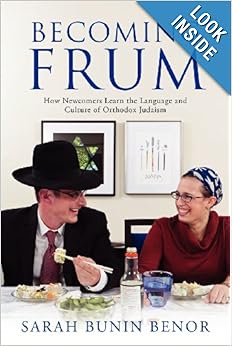
I promised a full-length review of Becoming Frum: How Newcomers Learn the Language and Culture of Orthodox Judaism by Sarah Bunin Benor (Rutger’s University Press 2012)  a while back, but I (embarrassing to admit!) lost the book before I completed it! (Yes, I feel guilty.)

becoming frum

Becoming Frum, recent winner of the Rohr Prize

Thank G-d, the book re-emerged from the piles on my desk recently, and I finally completed it over the weekend, allowing me to at long-last fulfill my promise to review this book, which recently won the 2013 Sami Rohr Choice Award for Jewish Literature

I first became acquainted with the work of Sarah Bunin Benor when she looked for volunteers to complete an online survey of language use among Jewish Americans several years back. When Becoming Frum came out a year ago, I was even more interested, partly because of my sociolinguistics coursework as part of my graduate-level anthropology program, partly because of my own status as a “BT” (someone who “returned” to Orthodox Jewish observance as an adult).

Becoming Frum draws on Benor’s extensive research among both “black hat” and “modern” Orthodox communities. Continue reading

Mormon and Orthodox Jewish writers: Does optimism hold back fine writing?

Mark Oppenheimer, in last Friday’s New York Times, posited that the optimistic attitude embraced by Mormons has prevented them from creating literary fiction. Sure, they have succeeded in Sci-fi (Orson Scott Card), fantasy (Stephanie Meyer), and books for teens and children (Shannon Hale, James Dashner, J. Lloyd Morgan).  But how many Mormon writer’s have won Pulitzers, National Book Awards, Bookers, or Nobels?

Oppenheimer interviewed a number of Mormon writers for his article, and includes some interesting insights:

“It is a fair thing to point out,” said Shannon Hale, a Mormon who writes young adult fiction, “that there have been very prominent Jewish writers that have received a lot of accolades, and worldwide the number of Mormons are comparable to the number of Jews, so why hasn’t that happened?”

Ms. Hale’s theory is that literary fiction tends to exalt the tragic, or the gloomy, while Mormon culture prefers the sunny and optimistic.

And also:

“I’ll tell you why they write young adult,” said Ms. Nunes. “Because they don’t have to write the pages and pages of sex. They don’t want to spend a lot of time in the bedroom.”

Another author pointed out that since Mormon theology strongly identifies with the idea of a Messianic redemption, Mormon writers gravitate towards the “savior motif.”

This all got me thinking. Even though Ms. Hale correctly identified Jews as successful authors of literary fiction, Orthodox writers are not foremost among them (despite examples of some who are, like Ruchama King Feuerman and Risa Miller and even, I’d argue, Bracha Rosman and Henye Meyers). And guess what? Continue reading