The Rejection Letter that’s Good for You

Yesterday, I got a rejection letter.

Yes, it happens a lot.

I’ve argued in the past that rejection letters are good for you, and I’ve gotten better at taking them in stride, but this one went even further. Its timing couldn’t have been more perfect.

You see, last night was my monthly writers’ workshop. All morning, I’d been trying to decide on a piece to bring and share. When that rejection letter appeared in my inbox around noon, I decided it was a sign.

No, not that kind of sign.

Not just a sign, but a Sign — “This is the piece you should bring to your writers’ workshop tonight.”

So, I did.

And it was magical.

Our group was smaller than usual, consisting of just three of us (usually, we’re four or five). But the two other ladies present gave me so much insight about what worked in my story and what did not, feedback that I might have been less open to, had I not just received the rejection letter. I spent a good chunk of this morning working on revisions, and plan to wrap them up tomorrow in between baking my challah and roasting my chicken.

I’m still hoping that the next time I hear from an editor, they send an acceptance letter. (To say that I pray for acceptance letters is no exaggeration.) But this experience is definitely going to help me embrace the next rejection letter.

Because another will surely come.
In case you need to feel validated for writing literary fiction, science will back you up

I’m not usually the type to post an hour before Shabbos starts, but this news item (first heard this morning during the break between some Mozart and some Corelli on KUSC) is just too wonderful to wait.

In case you feel defensive because you still think high-quality literature belongs in schools, or you’re trying to encourage quality over quantity in your own writing (thus spending way more time on each piece than seems wise), a new study indicates that reading literary fiction (Jane Austen, Don DiLillo, Chekov, or Alice Munro) temporarily enhances a reader’s emotional intelligence.

For more, read the study’s abstract here and a New York Times piece about it here.

New Jewish year, new books by Jewish authors!

The new Jewish year is marked this time around with several new book releases that have me very excited:

1) After being mesmerized by The World to Come and In the Image, I can’t wait to read Dara Horn’s newest, A Guide for the Perplexed, which was officially published today. An essay by the author appeared in The New York Times this week, reminding of the book’s release. The topic was the role of memory in literature — particularly in Jewish literature — which Horn tied to Rosh Hashanah. (The holiday falls later this week, and it’s also known as “The Day of Remembrance.”) Her new novel reportedly draws on this theme as it follows two contemporary characters obsessed with the work of the Rambam.

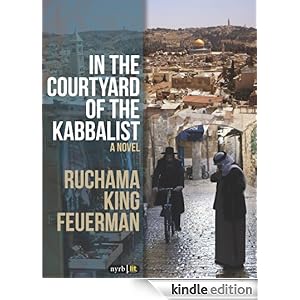
in the courtyard of the kabbalist

Ruchama King Feuerman’s latest, just out

2) Ruchama King Feuerman’s In the Courtyard of the Kabbalist follows an assortment of characters in Jerusalem. I’m very blessed that the author has sent me an advance copy — a review here on the blog will be forthcoming. I was a big fan of her last book, Seven Blessings, as well as some of her more recent, shorter work. Feuerman has been called “a Jewish Jane Austen,” probably because her character portraits so marvelously balance positive and negative qualities. I’m already a few dozen pages in to the new book and really getting into it. For a recent review, see here.

3) Ofir Touche Gafla’s The World of the End will soon be published in English. Continue reading

Background on my new story: “Just Perfect” (or why I believe we all live in a Magical Reality)

This week, Hamodia‘s Inyan Magazine published my new short story (and it’s actually for adults!), entitled “Just Perfect.”

The original version of the story was explicitly a piece of fantasy, but as I mentioned in a previous post, I transformed the story into an example of magical realism rather than fantasy in order to address the concerns of my lovely and knowledgeable editor at Hamodia. 

In the original version, then called “Easy as Pie,” the transformation of Libby’s life occurred after she bumped into a little old lady who offered her a slice of peach pie at a party. The pie made Libby’s life–well, just peachy. But my editor felt the little old lady was a little unbelievable. Could I cut her? The only problem was that her brief appearance at the beginning and the end of the story explained the wacky events in between.

I wracked my brains for a way to ditch the old lady but save the rest of the silliness. There had to be an explanation for it, after all. I did a bit of experimentation and research. Finally, I decided that maybe Libby should just pray–and then G-d answers.

Even after I found my “magically real” solution, I initially balked at making the change. It was an elegant solution, so my reaction puzzled me. I had to think about it a lot, and I think my conclusion is worth sharing. Continue reading

Which part is historical and which part is fiction? My Semi-official 39 Clues Rant

Book 10: Into The Gauntlet

It’s by the fantastic writer Margaret Peterson Haddix. What’s there not to like?

This post might get me in trouble with my kids, but so be it.

In case you don’t know The 39 Clues is a book series for middle grade readers (roughly kids 8-12). I think the initial target audience was older, but that’s who’s reading this series in my neck of the woods.

Kids love these books. They are exciting and are so engaging as to be addictive. Tweens clamor for more titles, which are delivered to bookstores at an astonishing rate. They are written by some top names in kids’ lit, like Rick Riordan, Margaret Peterson Haddix, and (one of my faves) Linda Sue Park. What’s there to dislike?

Here’s my beef.

The 39 Clues series freely borrows from historical fact, then elaborates on this to create a thrilling adventure for kids. Continue reading

Why I think speculative fiction is just SO Jewish (& you should, too)

One of the things I most like to write (and find it hard to sell) is Jewish speculative fiction. Speculative fiction is a wide-ranging label that includes genres like fantasy, science-fiction, and horror. Basically, in speculative fiction, the author suggests a scenario that proposes the question: “What if_______?”

What if…

…you found out that you weren’t a friendless orphan but a powerful wizard with many supporters? (Harry Potter)

…you discovered the back of the wardrobe led into a magical realm where you became royalty? (Narnia)

…you discovered there was a way to communicate with aliens through your dental work? (Fat Men From Space)

…you accidentally returned to the time of the Holocaust during your Pesach Seder? (The Devil’s Arithmetic)

While Isaac Asimov, Jane Yolen, Harlan Ellison, Daniel Manus Pinkwater, and many other secular Jewish Americans (as well as the Orthodox writer, Michael Burstein and the Israeli writers Lavie Tidhar and Nir Yaniv) have written speculative fiction to great acclaim–even Jewish speculative fiction–specifically Orthodox Jewish speculative fiction is much harder to find. As I have mentioned previously on my blog (and again, and again), there has been movement into this direction. But still, I get a lot of funny looks when I tell people what I most like to write.

But I don’t get it. I think speculative fiction is just SO Jewish, and so should you. Here’s why: Continue reading