The new Tablet story my editor is afraid I’m going to get hate mail for

My newest piece is up on Tablet. When I submitted the pitch several months ago to the Life and Religion editor, Wayne Hoffman, he cautioned me: do you really want to do this?

The topic of the essay is a controversial one in the Jewish community — women wearing Tefillin — and he was afraid I’d get a lot of trolls. And probably some genuine hate mail, to boot.

My original proposal was a much wider topic — the denigration of traditional feminine roles by many “feminists” in the Jewish community. I shot off the query letter in a fit of pique after yet another feminist looked down her nose at my lifestyle and basically told me I was so persecuted I didn’t know that I was persecuted.

The first draft was a mess: too big, too venting, too…too…everything.

I have to really give credit to the very special Mr. Hoffman, who asked the right questions and nudged me in the right direction until I could be proud of the resulting essay. We cut most of the first draft, and narrowed the topic considerably, then tried to focus on the positive aspects of the story.

Anyway, I hope you check the essay out and share and comment and all that.
An interview with author Batya Ruddell

Today, I have the pleasure of sharing with you another interview. In this post, you’ll meet the funny, talented Batya Ruddell. For those of you who read Binah Magazine or Hamodia, her name will certainly be familiar. Batya is one of the foremost writers in the Hareidi world today, and her work is beloved both by readers and other writers. Next week, she’ll be presenting at the Jerusalem Writers’ Conference, and this week, she’s answered a few questions for me via email.

RK: How long have you been writing? First, as an amateur, and then professionally? 

BR: I think I was writing in the womb!! Seriously, for as long as I can remember I’ve had a pen in my hand. Writing was always my passion but a botched attempt at getting into Journalism school (I knew NOTHING about politics or current events, LOL), led me down a different path to a career as a pediatric and neonatal intensive care nurse. I worked in this field for almost three decades before switching tracks to my initial dream a few years ago and becoming a professional writer. 

Continue reading

Announcing a class for beginning Jewish writers in L.A.

Do you have a picture book idea?

Have you always wanted to write for the Jewish magazines, but didn’t know how?

I will, G-d willing, be teaching a workshop on writing for Jewish tots, tweens, and teens later this month.

A possible student for my workshop?

Audience: Ladies ages 15 and up are welcome to participate.

Date:May 25th

Time:10 am – 1 pm

Location:Private home in L.A.

Cost:$25, $18 if you refer a friend and they also commit

To sign up: Please fill out the form below.

Go back

Your message has been sent

Warning
Warning
Warning
Warning
Warning
Warning

Warning.

I Live With My Mommy: new Jewish picture book addresses life with a single mother

Today, I’d like to share with you this interview with Tzvia Ehrlich-Klein, the author of the upcoming picture book I Live With My Mommy. This new, groundbreaking picture book for the first time focuses on growing up in a single-parent, Orthodox Jewish home. I learned about the book through its illustrator, the gifted Dena Ackerman, and upon my request, she hooked me up with Tzvia for a bit of Q & A via email.

picture book about Jewish home and divorce

I Live With Mommy, Tzvia Ehrlich-Klein’s new book about growing up with an Orthodox single mother.

RK: What led you to write about children living with a single mother?

TEK: Over 30 years ago I got divorced. At that time it was — or at least seemed to be — very rare [in the Orthodox community]. Walking my (approximately) 4-year-old daughter home from gan (nursery school) with her friend, I overheard her explaining to her friend: “No, my abba (daddy) didn’t die. They got ‘vorced.”

Continue reading

Megillat Esther through the eyes of a 21st century writer, or It’s okay if G-d saves the day if there’s forshadowing

This year, in preparation for Purim, I’ve been rereading the megillah at a class given by my LOR (local Orthodox rabbi). Of course, it’s not the first time I’ve read The Book of Esther, as it’s called in English. We do that every year on Purim–twice! And it’s also not the first time I’ve learned it with this particular rabbi. But it is the first time I’ve read it with commentary, guided by my rabbi, since I officially became an author (whatever that means). And boy, is there a difference.

The Big Literary No-No All Over the Megillah

book of esther theater poland

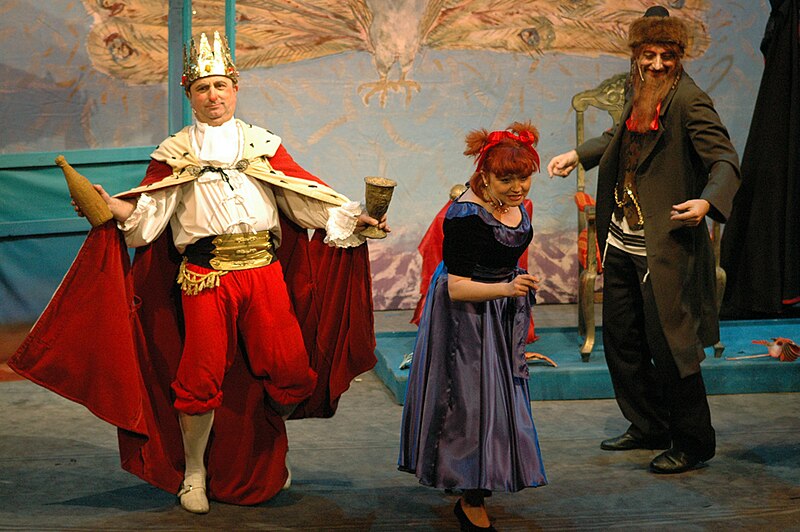
A Purim Spiel in Poland. Photo shared in the Wikipedia Commons by Henryk Kotowski.

When you’re writing fiction, there is a big no-no that you’re told never to do: rely on deus ex machina. In short: don’t get your characters out of a tight corner by dropping a deity down from the sky to perform an instantaneous rescue. The audience will roll their eyes, at best.

The term originated with actors playing deities in the theaters of Greece. But for a religious writer of a different persuasion in the 21st century, it causes problems. Continue reading