How Jewish do you sound? Learning the lingo as you learn the ropes

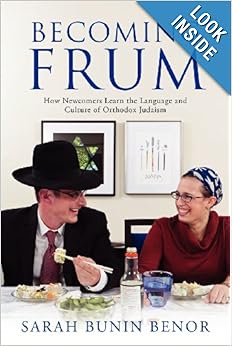
I promised a full-length review of Becoming Frum: How Newcomers Learn the Language and Culture of Orthodox Judaism by Sarah Bunin Benor (Rutger’s University Press 2012)  a while back, but I (embarrassing to admit!) lost the book before I completed it! (Yes, I feel guilty.)

becoming frum

Becoming Frum, recent winner of the Rohr Prize

Thank G-d, the book re-emerged from the piles on my desk recently, and I finally completed it over the weekend, allowing me to at long-last fulfill my promise to review this book, which recently won the 2013 Sami Rohr Choice Award for Jewish Literature

I first became acquainted with the work of Sarah Bunin Benor when she looked for volunteers to complete an online survey of language use among Jewish Americans several years back. When Becoming Frum came out a year ago, I was even more interested, partly because of my sociolinguistics coursework as part of my graduate-level anthropology program, partly because of my own status as a “BT” (someone who “returned” to Orthodox Jewish observance as an adult).

Becoming Frum draws on Benor’s extensive research among both “black hat” and “modern” Orthodox communities. Continue reading

In the Courtyard of the Novelist: An interview with Ruchama King Feuerman

I’ve got a treat here today: an interview (conducted via email) with award-winning author, Ruchama King Feuerman. Her latest book, In the Courtyard of the Kabbalist, just came out in September as an ebook. Recently, she signed a contract to expand the release to paperback. I became acquainted with Ruchama through Tablet Magazine online, where both of us have published essays. She was gracious enough to send me a copy of her new book and even more gracious to answer a few questions the novel left me with.

R.K. – In your first book, Seven Blessings, the central figure is a very strong female character. In this new book, you primarily follow two male, unmarried characters. What was that like for you as a married woman?

new book from Ruchama King Feuerman

In the Courtyard of the Kabbalist, now out from NYRB LIT

R.K.F.I prefer writing from the male point of view. This way I don’t worry about slippage, about parts of  my personality leaking into my characters, it’s just cleaner — what’s me is me, and what’s them is them.  I feel much freer to invent and have fun when I write as a man.  I do tend to prefer singles maybe because they are inherently dramatic. Continue reading

Different strokes for different folks: How one book can inspire so many others

A while back, someone my husband respects very much encouraged him to read this book:

Stop Surviving Start Living Shafier

Rabbi Shafier’s book, based largely on Mesillas Yesharim

The first time I read Rabbi Shafier’s book, Stop Surviving, Start Living, I just didn’t get it. Not the content of the book — the content was clear as day, written lucidly by Rabbi Shafier, with nice anecdotes and everything. What I didn’t get was that it was based on a book my husband had already read. This one: Mesillas Yesharim, known in English as The Path of the Just, one of the most foundational texts in the Mussar world.

Mesillas Yesharim by the RAMCHAL

The original. So inspirational…and a bit scary for the uninitiated.

Why, I asked my husband, write a book based on another one, a book that you actually want people to read (because you’re such a fan yourself)? Continue reading

Reading local-to-L.A. authors

One of my favorite things to do is to promote the work of Jewish writers with West Coast connections. Here are a few I’ve read in the last couple months:

Hands-On How To’s for the Home & Heart by Tova Younger (Shemtov Press 2012)

TOVA YOUNGER final cover

Tova Younger’s recent release

Tova Younger is a former Angeleno who settled in Kiryat Sefer in 2004. Her new book, Hands-On How To’s for the Home & Heart, contains friendly and very practical advice of all types for the Jewish wife.

When I was first living on my own, someone gave me a book, Where’s Mom Now That I Need Her: Surviving Away from Home. That cookbook/home repair/car repair/first aid/ and just about everything else manual got me through a lot of tough situations. Younger’s book is almost a Jewish version of that secular classic—chock full of basic information that every Jewish homemaker can benefit from.

Divided up into four primary sections:

  • For the Heart
  • For the Home
  • Handy Tips
  • recipes

Hands-On How To’s for the Home & Heart offers advice about everything from maintaining proper kavana (focus) to proper laundering; from how to make conversation with the relatives to whom we owe kavod (honor), to recipes for basics like beet salad and cornflake quiche.

Younger’s book would make a terrific gift for seminary girls, the newly married, and even seasoned homemakers. You can find it on discount right now at Jewish e-Books.

Bells & Pomegranates by Rachel Pomerantz (Menucha Publishers 2012)

bells and pomegranates

Rachel Pomerantz’s latest

Well-known Orthodox author Rachel Pomerantz frequently travels to SoCal to visit her brother and mother, who live near San Andreas. Her latest serial novelization, Bells & Pomegranates, follows the shidduch process of various characters (introduced in previous books), all of whom have life circumstances that present hurdles in their quest for a mate.

There are step-siblings Yoel and Devora, who have been adopted, and the twins Rina and Gila, who converted as children and grew up in a single parent home. There’s foster child Ronny, whose mother is mentally ill, and Yossi, the child of baalei teshuva. Sarah’s got great yichus, but she’s an orphan. These characters and others start off the shidduch process with considerable challenges—but as the novel progresses, Pomerantz throws additional complications into their paths, lending drama and suspense to their intermingled stories.

Bells & Pomegranates is more than kosher entertainment for a rainy afternoon. In describing the family dramas of her characters, Pomerantz invites us to question our own preferences and prejudices. How do my assumptions affect my judgment? How involved should parents and grandparents be in the shidduch process? What are legitimate reasons to call off a prospective match? These questions and others lingered with me after I finished the book.

On This Night: the Steps of the Seder in Rhyme by Nancy Steiner (HaChai 2013)

on this night

While a seasoned freelance author, Nancy Steiner is new to picture book writing. Her first kids’ title, On This Night, will likely prove to be a classic. In cheerful—but unforced—rhyme, Steiner leads readers through the steps of the seder. Her language is perfectly accessible for young readers and will prepare them for the Pesach experience.

The darling illustrations by Wendy Edelson depict an adorable family celebrating their seder. Edelson portrays the family members from a variety of angles, adding to the visual interest. From the twinkly-eyed zeide to the drowsy preschooler on the final page, the pictures (and text) are sure to engage kids aged 2 to 6.

Also of note:

L.A. resident Sarah Bunin Benor’s new book, Becoming Frum (Rutgers University Press 2012), considers the ways newly religious Jews adapt to the language of the mainstream Orthodox world. While an academic book rather than a religious one, Bunin Benor bases her conclusions largely on research conducted here in L.A., and her book will be of great interest of those engaged in the baalei teshuva phenomenon. I participated in her initial online survey, which piqued my interest in her work. I hope to write an entire post devoted to Bunin Benor’s book (and her spin-off website) soon.
Looking for a gift? 5 New books to consider this Chanukah season, including Red is My Rimon, Chanukah Guess Who?, The Torah Book of Opposites, The Wooden Sword, and The Tempest in the Tea Room

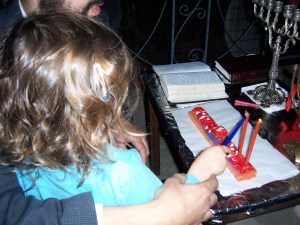
lighting chanukiah with abba

Chanukah is coming! Did you remember to get this cutie a gift?

In the upcoming Chanukah edition of CitySpirit Magazine (available here in L.A. within the next week or so), you’ll find reviews of four books either authored or illustrated by local L.A. talent. Any of them would make perfect gifts for Chanukah for kids. The books I reviewed for CitySpirit (with links to their pages on Amazon) are:

Red is My Rimon

Chanukah Guess Who?

The Torah Book of Opposites

The Wooden Sword

If you’re looking for a Chanukah gift for a teen or an adult reader, why don’t you check out Libi Astaire’s newest The Tempest in the Tea Room.  Continue reading

When is an author a Jewish author? Defining Jewish writing, Part 3

Last week was marked by big news in the book world. Famed-American Jewish author (Jewish meaning author’s ethnicity only, in this case–see previous posts on the subject) Philip Roth has declared that he’s retiring from writing. On the other hand, equally aged and famous American-Jewish author Herman Wouk has just put out another novel. Interestingly, these events didn’t just make headlines in Jewish publishing, but publishing as a whole.

The stereotypical Jew is considered “bookish,” pale due to the amount of time he spends indoors. We are called “the People of the Book.” How is it that Jews became inextricably interwoven with books? Continue reading