In the Courtyard of the Novelist: An interview with Ruchama King Feuerman

I’ve got a treat here today: an interview (conducted via email) with award-winning author, Ruchama King Feuerman. Her latest book, In the Courtyard of the Kabbalist, just came out in September as an ebook. Recently, she signed a contract to expand the release to paperback. I became acquainted with Ruchama through Tablet Magazine online, where both of us have published essays. She was gracious enough to send me a copy of her new book and even more gracious to answer a few questions the novel left me with.

R.K. – In your first book, Seven Blessings, the central figure is a very strong female character. In this new book, you primarily follow two male, unmarried characters. What was that like for you as a married woman?

new book from Ruchama King Feuerman

In the Courtyard of the Kabbalist, now out from NYRB LIT

R.K.F.I prefer writing from the male point of view. This way I don’t worry about slippage, about parts of  my personality leaking into my characters, it’s just cleaner — what’s me is me, and what’s them is them.  I feel much freer to invent and have fun when I write as a man.  I do tend to prefer singles maybe because they are inherently dramatic. Continue reading

Even turtles have to poke their heads out sometimes

What makes Jewish literature Jewish?

In theory, I’m on vacation, make that staycation, with my kids and not posting. However, in the last week, two authors I respect both posted on a topic I’ve contemplated before: what is Jewish literature? Their ideas were both useful and inspirational. It’s worth reading the posts. You can read Libi Astaire’s post here and Erika Dreifus’s here.

On a related note, after a short hiatus, Tablet has started posting fiction again. I’m wondering if the complaints about whether their previous stories were examples of Jewish literature had an effect — both the recent pieces have been translations of Israeli authors.

When the trolls try to drag those you love under the bridge.

knight fights troll

“Take that, you nasty troll! Maybe you’ll think twice before saying mean things about my sister again!”

I hate trolls.

Not the fictional kind. The internet kind. I’ve blogged about it before.

But now, my sister has published her first piece on Tablet. And the very first comment she got was from a troll. A mean, nasty one who called her names.

If getting mean-spirited comments from random strangers is bad, having your sister get them is worse. I’m irate! I’m disgusted.

I have commented.

Fair readers: go read my sister’s essay — and say something nice in the comments. (Even if it means you have to learn how to use Discus.)

K?

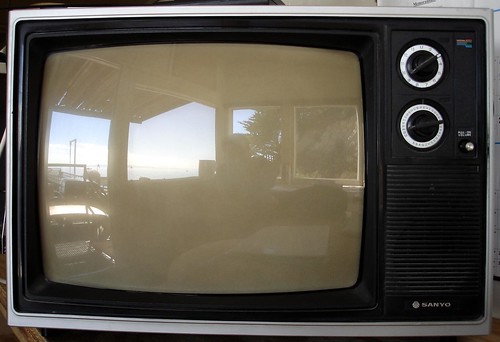
Books–still better than TV?

Liel Liebovitz, on Tablet Magazine this week, argues that TV is for Dummies.

old TV

Photo of Sanyo TV courtesy of Kevin Simpson via Flickr

Like most titles, this one exaggerates Mr. Liebovitz statement: that even if TV has achieved more creative sophistication than ever before, it still fails to reach the majesty of the written word (or something to that effect). In his mind, books are still king. He bases his argument, as I understand it, on the inability of a visual art form to capture the interior life of characters, using a passage written by Henry James as evidence. In the first hour online, Mr. Liebovitz has received 19 comments on his article.

Well, I haven’t had a TV set in my home since 2000, so I can’t really attest to the increase quality of television programming in the last few years. Continue reading

Soul-bearing writing–writing personal essays that are a little too personal for comfort

Tablet published a new piece of mine today, about the untidy family life of a person who is an Orthodox Jew with relatives who are devout Christians. The comments are busy, and no trolls have appeared so far (meaning that anyone who disagrees with me does so with politeness and reflection).

I’ve published the piece because the problem I described in the article is a surprisingly common one  (among the “baalei teshuvos” who come to religiosity as adults) that most people ignore.

It’s sorta mortifying. This is a problem that is very private for me, and–like many who share it–it is a source of pain that I usually sweep under the rug. I’ve had to explain the absence of half of my family to many people over the years, and it’s never comfortable. Now the entire world can read about it (and share! and comment!).

In general, I don’t write about my family unless it is 100% positive. I felt that this needed to be an exception, in order to support people who share this type of situation. I intentionally omitted the name of my father’s family, and I tried to protect their identities. I wanted not to expose them, but the problem. Nonetheless, one of the commenters pointed out that I was still airing my family’s laundry in public.

I’d love it if readers weighed in here (in a comment below) or in the comments section on Tablet.

<a href=”http://www.makealivingwriting.com/?p=2538″><img src=”http://www.makealivingwriting.com/wp-content/uploads/2013/04/MALW_linkparty1.jpg”/></a&gt;