Background on my new story: “Just Perfect” (or why I believe we all live in a Magical Reality)

This week, Hamodia‘s Inyan Magazine published my new short story (and it’s actually for adults!), entitled “Just Perfect.”

The original version of the story was explicitly a piece of fantasy, but as I mentioned in a previous post, I transformed the story into an example of magical realism rather than fantasy in order to address the concerns of my lovely and knowledgeable editor at Hamodia. 

In the original version, then called “Easy as Pie,” the transformation of Libby’s life occurred after she bumped into a little old lady who offered her a slice of peach pie at a party. The pie made Libby’s life–well, just peachy. But my editor felt the little old lady was a little unbelievable. Could I cut her? The only problem was that her brief appearance at the beginning and the end of the story explained the wacky events in between.

I wracked my brains for a way to ditch the old lady but save the rest of the silliness. There had to be an explanation for it, after all. I did a bit of experimentation and research. Finally, I decided that maybe Libby should just pray–and then G-d answers.

Even after I found my “magically real” solution, I initially balked at making the change. It was an elegant solution, so my reaction puzzled me. I had to think about it a lot, and I think my conclusion is worth sharing. Continue reading
Fans, friends, and trolls–publishing my first piece on Tablet

So, Tablet published a piece of mine this week. It’s been a crazy experience.

In the first place, writing the piece was a bit out of my comfort zone. While I usually write fiction, this is a personal essay. In brief, the story is about confronting my inner teenager as I’m approaching 40 and relates an episode where I thought a younger man was checking me out in a cafe.

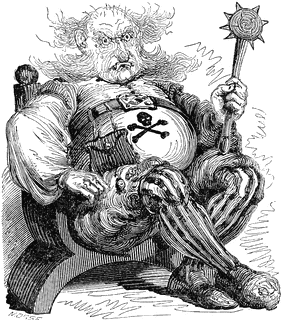
Troll

Trolls don’t only live under bridges.

The subject matter was outside the editorial policies of the chareidi magazines that comprise my usual stomping grounds, so I had to find an alternative publisher. Afraid I might embarrass my husband, I almost decided not to publish it at all, but he assured me that he didn’t mind. And when I shared an early draft with writing friends, the strongly positive reaction encouraged me further.

Tablet accepted my query, then the completed essay. They had it up in a matter of days. Whoa. It didn’t leave me much time to prepare myself. And, boy, did I have to prepare myself.

You see, there’s a lot of differences between a Jewish, but broad-spectrum, online magazine like Tablet and print magazines in the chareidi world. The biggest difference is the comments section.

In a print magazine, there is no comments section. Continue reading

On Writing About Writing: a guest post by Miriam Hendeles, author of Mazel Tov, It’s a Bubby!

Mazel Tov! It's a Bubby!

Miriam’s Book!

Today’s guest post is from my partner in crime writing, Miriam Hendeles.

What do writers write about? We write about our lives and our families. Some of us write about our struggles and triumphs. Others write about philosophies and opinions; hope and dreams.

We tell stories, and conduct interviews; we compose lists and craft essays.

We even write about “Writing.” Now what is there to tell, conduct, compose and craft about Writing?

So much. We can write about the writing process, solutions to writer’s block, publishing opportunities, strategies for success, online writing techniques, SEO, PLR and myriad other acronyms. Bloggers and gurus craft advice to the masses on how to become the most polished, pithy, and popular Writer. You see, many writers choose to write about Writing, because if we write about Writing, we know we are guaranteed an audience, comprised of the following loyal and faithful readers:

Writers. Wannabe writers. Bloggers. Publishers. Agents. Editors.

But when we do not write about Writing? Then who is our audience?

Random Interested Persons of Non-Writing topic.

For example, Continue reading

How Texans lost their accents and the newly religious found one

How do we place a person? Partly by the way they talk. But the accents that we use to locate people are constantly in flux.

Apparently Texans are losing their distinct accents. Still others have mastered mainstream American dialects as well as their own distinct drawl and codeswitch according to the demands of the situation, a recent study at the University of Texas asserts. The L.A. Times article on the subject explains some of the reasons, which include exposure to mass media and immigration to Texas from a variety of sources.

The article piqued my interest in part because I happen to be reading Sarah Bunin Benor’s new book Becoming Frum which contemplates the ways the newly religious adopt the language and cultural markers of Orthodox Jews. Like with the Texans discussed above, some use of the in-group dialect is conscious, while other use is not. But in either case,  it marks the users of certain types of speech as members of a distinct group.

What this means to writers: A sprinkle of regional dialect or in-group word choice can help establish a character in the social landscape of our story/book and make them sound authentic. But misuse of language based on out-dated understandings of a community could annoy readers just as much as heavy-handed overuse. Pretty soon, we might not be able to write characters with Texan drawls anymore without sounding ridiculously retro. It’s good to have a handle on these nuances of language use before jumping in to this writing strategy.

Why I think speculative fiction is just SO Jewish (& you should, too)

One of the things I most like to write (and find it hard to sell) is Jewish speculative fiction. Speculative fiction is a wide-ranging label that includes genres like fantasy, science-fiction, and horror. Basically, in speculative fiction, the author suggests a scenario that proposes the question: “What if_______?”

What if…

…you found out that you weren’t a friendless orphan but a powerful wizard with many supporters? (Harry Potter)

…you discovered the back of the wardrobe led into a magical realm where you became royalty? (Narnia)

…you discovered there was a way to communicate with aliens through your dental work? (Fat Men From Space)

…you accidentally returned to the time of the Holocaust during your Pesach Seder? (The Devil’s Arithmetic)

While Isaac Asimov, Jane Yolen, Harlan Ellison, Daniel Manus Pinkwater, and many other secular Jewish Americans (as well as the Orthodox writer, Michael Burstein and the Israeli writers Lavie Tidhar and Nir Yaniv) have written speculative fiction to great acclaim–even Jewish speculative fiction–specifically Orthodox Jewish speculative fiction is much harder to find. As I have mentioned previously on my blog (and again, and again), there has been movement into this direction. But still, I get a lot of funny looks when I tell people what I most like to write.

But I don’t get it. I think speculative fiction is just SO Jewish, and so should you. Here’s why: Continue reading