How Jewish do you sound? Learning the lingo as you learn the ropes

I promised a full-length review of Becoming Frum: How Newcomers Learn the Language and Culture of Orthodox Judaism by Sarah Bunin Benor (Rutger’s University Press 2012)  a while back, but I (embarrassing to admit!) lost the book before I completed it! (Yes, I feel guilty.)
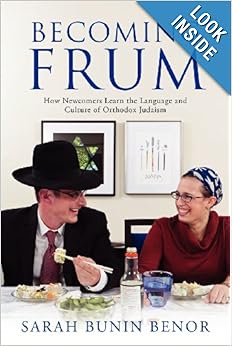
becoming frum

Becoming Frum, recent winner of the Rohr Prize

Thank G-d, the book re-emerged from the piles on my desk recently, and I finally completed it over the weekend, allowing me to at long-last fulfill my promise to review this book, which recently won the 2013 Sami Rohr Choice Award for Jewish Literature

I first became acquainted with the work of Sarah Bunin Benor when she looked for volunteers to complete an online survey of language use among Jewish Americans several years back. When Becoming Frum came out a year ago, I was even more interested, partly because of my sociolinguistics coursework as part of my graduate-level anthropology program, partly because of my own status as a “BT” (someone who “returned” to Orthodox Jewish observance as an adult).

Becoming Frum draws on Benor’s extensive research among both “black hat” and “modern” Orthodox communities. Continue reading

Mormon and Orthodox Jewish writers: Does optimism hold back fine writing?

Mark Oppenheimer, in last Friday’s New York Times, posited that the optimistic attitude embraced by Mormons has prevented them from creating literary fiction. Sure, they have succeeded in Sci-fi (Orson Scott Card), fantasy (Stephanie Meyer), and books for teens and children (Shannon Hale, James Dashner, J. Lloyd Morgan).  But how many Mormon writer’s have won Pulitzers, National Book Awards, Bookers, or Nobels?

Oppenheimer interviewed a number of Mormon writers for his article, and includes some interesting insights:

“It is a fair thing to point out,” said Shannon Hale, a Mormon who writes young adult fiction, “that there have been very prominent Jewish writers that have received a lot of accolades, and worldwide the number of Mormons are comparable to the number of Jews, so why hasn’t that happened?”

Ms. Hale’s theory is that literary fiction tends to exalt the tragic, or the gloomy, while Mormon culture prefers the sunny and optimistic.

And also:

“I’ll tell you why they write young adult,” said Ms. Nunes. “Because they don’t have to write the pages and pages of sex. They don’t want to spend a lot of time in the bedroom.”

Another author pointed out that since Mormon theology strongly identifies with the idea of a Messianic redemption, Mormon writers gravitate towards the “savior motif.”

This all got me thinking. Even though Ms. Hale correctly identified Jews as successful authors of literary fiction, Orthodox writers are not foremost among them (despite examples of some who are, like Ruchama King Feuerman and Risa Miller and even, I’d argue, Bracha Rosman and Henye Meyers). And guess what? Continue reading

In the Courtyard of the Novelist: An interview with Ruchama King Feuerman

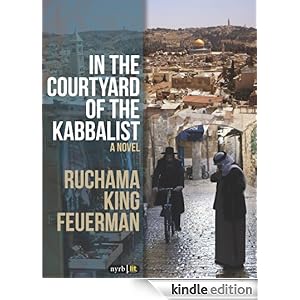
I’ve got a treat here today: an interview (conducted via email) with award-winning author, Ruchama King Feuerman. Her latest book, In the Courtyard of the Kabbalist, just came out in September as an ebook. Recently, she signed a contract to expand the release to paperback. I became acquainted with Ruchama through Tablet Magazine online, where both of us have published essays. She was gracious enough to send me a copy of her new book and even more gracious to answer a few questions the novel left me with.

R.K. – In your first book, Seven Blessings, the central figure is a very strong female character. In this new book, you primarily follow two male, unmarried characters. What was that like for you as a married woman?

new book from Ruchama King Feuerman

In the Courtyard of the Kabbalist, now out from NYRB LIT

R.K.F.I prefer writing from the male point of view. This way I don’t worry about slippage, about parts of  my personality leaking into my characters, it’s just cleaner — what’s me is me, and what’s them is them.  I feel much freer to invent and have fun when I write as a man.  I do tend to prefer singles maybe because they are inherently dramatic. Continue reading

New Jewish year, new books by Jewish authors!

The new Jewish year is marked this time around with several new book releases that have me very excited:

1) After being mesmerized by The World to Come and In the Image, I can’t wait to read Dara Horn’s newest, A Guide for the Perplexed, which was officially published today. An essay by the author appeared in The New York Times this week, reminding of the book’s release. The topic was the role of memory in literature — particularly in Jewish literature — which Horn tied to Rosh Hashanah. (The holiday falls later this week, and it’s also known as “The Day of Remembrance.”) Her new novel reportedly draws on this theme as it follows two contemporary characters obsessed with the work of the Rambam.

in the courtyard of the kabbalist

Ruchama King Feuerman’s latest, just out

2) Ruchama King Feuerman’s In the Courtyard of the Kabbalist follows an assortment of characters in Jerusalem. I’m very blessed that the author has sent me an advance copy — a review here on the blog will be forthcoming. I was a big fan of her last book, Seven Blessings, as well as some of her more recent, shorter work. Feuerman has been called “a Jewish Jane Austen,” probably because her character portraits so marvelously balance positive and negative qualities. I’m already a few dozen pages in to the new book and really getting into it. For a recent review, see here.

3) Ofir Touche Gafla’s The World of the End will soon be published in English. Continue reading

Considering my last year of literary pursuit

Since there are just two weeks left of the Jewish year of 5773, I’ve been looking back at the last year and evaluating my life on every level: spiritual, physical, and even professional. And one goal still stands out at unfulfilled:

I STILL HAVEN’T PUBLISHED BOOK #2.

This issue depressed me a couple weeks ago, as I sat in front of my journal on Rosh Chodesh Elul (exactly one month before Rosh Hashanah), scribbling about the past year. I’d submitted a few picture books and two novels to multiple publishers and had zilch to show for it.

But then I counted how many times I appeared in print in the last year for pay: over two dozen times (bli ayin hara).

And then, I counted how many words I’d written. Essentially, it was the length of a novel. Wow.

I realized at that point how many more readers — potentially thousands more people — read my work in magazines this year than in my entire previous professional life.

That’s when I felt blessed.

Okay, I still have a major unfulfilled goal. It will be top of my professional goals again for this 5774. But if success is measured in progress, I made a lot of progress last year. And I could only do it with G-d’s help, which makes the year feel very sweet indeed.

How are you feeling about your last year, professionally? What is your top goal for 5774?