How Jewish do you sound? Learning the lingo as you learn the ropes

I promised a full-length review of Becoming Frum: How Newcomers Learn the Language and Culture of Orthodox Judaism by Sarah Bunin Benor (Rutger’s University Press 2012)  a while back, but I (embarrassing to admit!) lost the book before I completed it! (Yes, I feel guilty.)
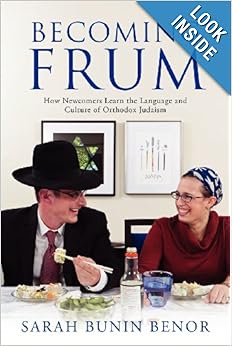
becoming frum

Becoming Frum, recent winner of the Rohr Prize

Thank G-d, the book re-emerged from the piles on my desk recently, and I finally completed it over the weekend, allowing me to at long-last fulfill my promise to review this book, which recently won the 2013 Sami Rohr Choice Award for Jewish Literature

I first became acquainted with the work of Sarah Bunin Benor when she looked for volunteers to complete an online survey of language use among Jewish Americans several years back. When Becoming Frum came out a year ago, I was even more interested, partly because of my sociolinguistics coursework as part of my graduate-level anthropology program, partly because of my own status as a “BT” (someone who “returned” to Orthodox Jewish observance as an adult).

Becoming Frum draws on Benor’s extensive research among both “black hat” and “modern” Orthodox communities. Continue reading


In the Courtyard of the Novelist: An interview with Ruchama King Feuerman

I’ve got a treat here today: an interview (conducted via email) with award-winning author, Ruchama King Feuerman. Her latest book, In the Courtyard of the Kabbalist, just came out in September as an ebook. Recently, she signed a contract to expand the release to paperback. I became acquainted with Ruchama through Tablet Magazine online, where both of us have published essays. She was gracious enough to send me a copy of her new book and even more gracious to answer a few questions the novel left me with.

R.K. – In your first book, Seven Blessings, the central figure is a very strong female character. In this new book, you primarily follow two male, unmarried characters. What was that like for you as a married woman?

new book from Ruchama King Feuerman

In the Courtyard of the Kabbalist, now out from NYRB LIT

R.K.F.I prefer writing from the male point of view. This way I don’t worry about slippage, about parts of  my personality leaking into my characters, it’s just cleaner — what’s me is me, and what’s them is them.  I feel much freer to invent and have fun when I write as a man.  I do tend to prefer singles maybe because they are inherently dramatic. Continue reading

What? No love triangle? How books for Jewish teens fit into current YA trends

If you ask observant Jewish teens here in the U.S. whether they overall prefer Jewish books or secular ones, most of them will tell you secular books (trust me, I write for teens, so I’ve asked). Sad, but true.

Why most Orthodox teens prefer secular books

Interestingly, some of these teens will tell you that they wish there were more Jewish books for teens that suited them. Others will tell you they don’t like either Jewish or secular novels — the former don’t engage them, and latter conflict with their religious beliefs.

Thursday, I caught an excellent article on CNN about the history of YA novels in the U.S. You can read it here. There was little that was news to me in the article, but it did make me think about something that’s troubled me for a while — namely why so many Jewish teens are enthralled by secular books that don’t necessarily reflect the values of their families.

Let’s consider why secular YA books are currently selling like hotcakes. Continue reading

My first foray into playwriting: lessons learned about writing and directing plays for kids

As I mentioned last week in passing, I spent a good chunk of time between Rosh Hashanah and Yom Kippur preparing a play for the kids at my synagogue. The topic: the story of Jonah, which is read during the afternoon of Yom Kippur.

Jonah sheltered by the vine

Yonah waiting to see if Nineveh gets destroyed. He’s kinda hoping it does. How’s that for schadenfreude?

Now, I’ve always thought this story was packed with humor. I mean, G-d singles Jonah out for a little tete-a-tete and he hops on a boat headed in the opposite direction as the mission G-d sent him on? Then he sleeps through the ginormous storm that has everyone else aboard freaking out and get swallowed by a giant fish. Come on!

And when Jonah finally makes it to Nineveh, it gets even wackier. Continue reading

Different strokes for different folks: How one book can inspire so many others

A while back, someone my husband respects very much encouraged him to read this book:

Stop Surviving Start Living Shafier

Rabbi Shafier’s book, based largely on Mesillas Yesharim

The first time I read Rabbi Shafier’s book, Stop Surviving, Start Living, I just didn’t get it. Not the content of the book — the content was clear as day, written lucidly by Rabbi Shafier, with nice anecdotes and everything. What I didn’t get was that it was based on a book my husband had already read. This one: Mesillas Yesharim, known in English as The Path of the Just, one of the most foundational texts in the Mussar world.

Mesillas Yesharim by the RAMCHAL

The original. So inspirational…and a bit scary for the uninitiated.

Why, I asked my husband, write a book based on another one, a book that you actually want people to read (because you’re such a fan yourself)? Continue reading