Due to the onslaught of housework, etc., that Pesach entails, as well as some nifty work assignments, I’ll be posting less for the next month or so. However, I do want to share with my readers several bits of good news: Continue reading
literature
4 Questions for author Tamar Ansh about her new Passover cookbook
I recently conversed via email with the enormously popular author, Tamar Ansh, about her new cookbook. Let My Children Cook! is her first cookbook for kids, and it tackles a particularly pertinent area of Kosher cuisine for this time of year: Passover.

Tamar Ansh’s latest cookbook, out in time for Passover!
4 Questions:
Rebecca:
What made you want to write a cookbook for children this time? And why specifically one for Passover?
Tamar:
For this book, Let My Children Cook!, Hashem sent me the inspiration from a totally unexpected angle. Continue reading
Megillat Esther through the eyes of a 21st century writer, or It’s okay if G-d saves the day if there’s forshadowing
This year, in preparation for Purim, I’ve been rereading the megillah at a class given by my LOR (local Orthodox rabbi). Of course, it’s not the first time I’ve read The Book of Esther, as it’s called in English. We do that every year on Purim–twice! And it’s also not the first time I’ve learned it with this particular rabbi. But it is the first time I’ve read it with commentary, guided by my rabbi, since I officially became an author (whatever that means). And boy, is there a difference.
The Big Literary No-No All Over the Megillah
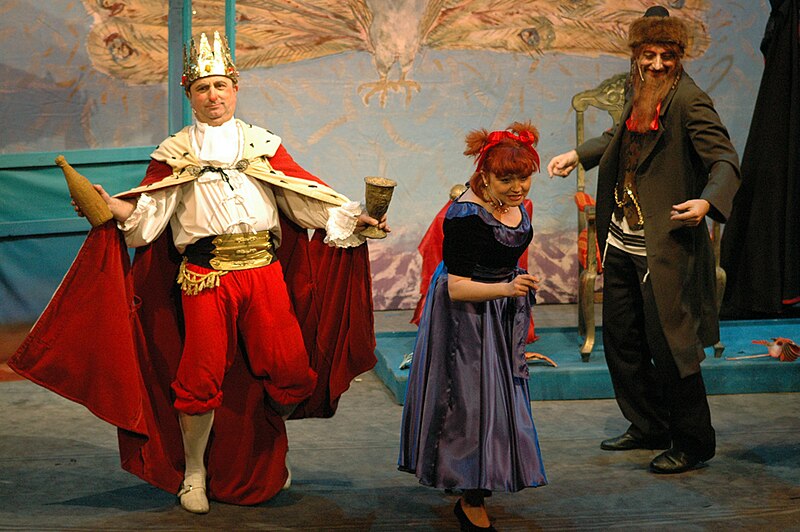
A Purim Spiel in Poland. Photo shared in the Wikipedia Commons by Henryk Kotowski.
When you’re writing fiction, there is a big no-no that you’re told never to do: rely on deus ex machina. In short: don’t get your characters out of a tight corner by dropping a deity down from the sky to perform an instantaneous rescue. The audience will roll their eyes, at best.
The term originated with actors playing deities in the theaters of Greece. But for a religious writer of a different persuasion in the 21st century, it causes problems. Continue reading
Reading is for everyone, even those with no bookshelf
In The L.A. Times, I just read a touching article by YA author Amy Goldman Koss about her efforts to offer reading material to the homeless. Her program is in a Glendale, California homeless shelter, but I was reminded of the role libraries play in the lives of the homeless, as well.
In local libraries, I’ve encountered the homeless on nearly every visit. Continue reading
Mormon and Orthodox Jewish writers: Does optimism hold back fine writing?
Mark Oppenheimer, in last Friday’s New York Times, posited that the optimistic attitude embraced by Mormons has prevented them from creating literary fiction. Sure, they have succeeded in Sci-fi (Orson Scott Card), fantasy (Stephanie Meyer), and books for teens and children (Shannon Hale, James Dashner, J. Lloyd Morgan). But how many Mormon writer’s have won Pulitzers, National Book Awards, Bookers, or Nobels?
Oppenheimer interviewed a number of Mormon writers for his article, and includes some interesting insights:
“It is a fair thing to point out,” said Shannon Hale, a Mormon who writes young adult fiction, “that there have been very prominent Jewish writers that have received a lot of accolades, and worldwide the number of Mormons are comparable to the number of Jews, so why hasn’t that happened?”
Ms. Hale’s theory is that literary fiction tends to exalt the tragic, or the gloomy, while Mormon culture prefers the sunny and optimistic.
And also:
“I’ll tell you why they write young adult,” said Ms. Nunes. “Because they don’t have to write the pages and pages of sex. They don’t want to spend a lot of time in the bedroom.”
Another author pointed out that since Mormon theology strongly identifies with the idea of a Messianic redemption, Mormon writers gravitate towards the “savior motif.”
This all got me thinking. Even though Ms. Hale correctly identified Jews as successful authors of literary fiction, Orthodox writers are not foremost among them (despite examples of some who are, like Ruchama King Feuerman and Risa Miller and even, I’d argue, Bracha Rosman and Henye Meyers). And guess what? Continue reading
Is poetry as we know it dead? Goldsmith speculates the “meme machine” has taken over.
This week, The New Yorker book blog published a post by Kenneth Goldsmith about the proliferation of rather un-poetic “poetry” spreading across the internet. He writes:
[T]he Canadian media scholar Darren Wershler…has been making some unexpected connections between meme culture and contemporary poetry. “These artifacts,” Wershler claims, “aren’t conceived of as poems; they aren’t produced by people who identify as poets; they circulate promiscuously, sometimes under anonymous conditions; and they aren’t encountered by interpretive communities that identify them as literary.”
…It’s not uncommon to see blogs that recount someone’s every sneeze since 2007, or of a man who shoots exactly one second of video every day and strings the clips together in time-lapsed mashups. Continue reading
 Rebecca Klempner